Park Sites & Maps
The Blue Greenway is a 13-mile greenway/waterway network beginning at China Basin in the north and ending at San Francisco’s southern boarder. The Blue Greenway network connects a series of waterfront parks, each one with a rich history.
China Basin Park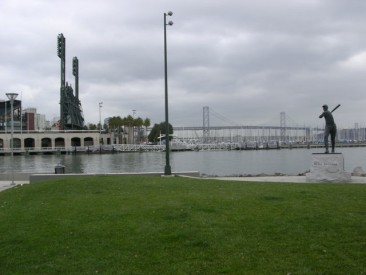
China Basin Park was built by the San Francisco Giants in coordination with the Port of San Francisco across McCovey Cove from AT&T Park. A statue of Giants Hall of Famer Willie McCovey presides over the northeast corner and carries, at its base, the names of all the Willie Mac Award winner. The park offers families grassy picnic areas and the Junior Giants Field-a tee ball field for young and physically challenged players. Its diamond, complete with backstop and outfield fence, gives kids the chance to hit a ball into the cove. Like Barry Bonds. The shoreline promenade with spectacular views of San Francisco Bay, has a 570 foot long seat wall with markers commemorating every year of Giants baseball from 1958 through 1999.
For more information about China Basin Park or please visit the SF Port website.
For more information about China Basin Seawall Lot 337 (SWL 337) please visit the SF Port website.
Bayfront Park
Coming Soon…
Agua Vista Park and Fishing Pier
Agua Vista Park and Fishing Pier runs along Terry Francois Boulevard between 16th and 18 streets. It was dedicated as open space in 1971, as a public access mitigation for the Port of San Francisco’s containerized shipping facility at the mouth of Islais Creek. In early 2000, Port improvements produced new concrete tables, security lighting, bike rack and an environmental sustainable previous (made of a new, permeable material) walkway connecting to the sidewalk, fishing pier and Mission Rock Resort, on the south. Bike riders, fishermen and Mission Rock diners share the waterfront pleasure of the park and the pier.
Pier 70
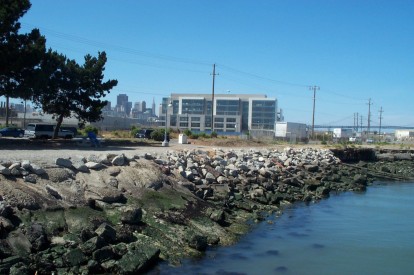
For more information about Pier 70 please visit the SF Port website.
Warm Water Cove
On any day you can see shore birds and the occasional seal as well as other birds, bees, butterflies, dragon flies and people at the Cove.
Now a gem of a quiet, unfussy waterfront San Francisco Port park, Warm Water Cove (24th Street at the Bay) was, until 2007, practically unknown except to graffiti “artists” and illegal dumpers! Formed of landfill in an industrial part of the City, the park has evolved organically to become a pleasant shoreline park.
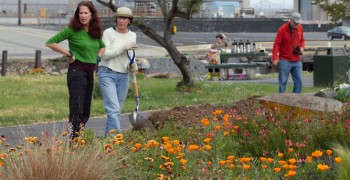
GreenTrustSF along with the Port and DPW gathered neighbors to clean up and take care of the park in the summer of 2007. Three flower gardens of California native and other drought –tolerant flowering plants were started in 2008, maintained by GreenTrustSF and SF Port gardeners.
January 2011, GreenTrustSF, with the Port, sponsored a native wildflower bed seeding with many neighbors joining in. A follow-up Earth Day Clean-up and gardening event was part of a Blue Greenway–wide effort along the eastern shoreline. Flowers continue to bloom.
The Garden Project has joined GreenTrustSF and the Port in stewarding Warm Water Cove, which has seen a big increase in visitors of all ages and interests—walking, biking, picnicking, shore-bird watching, and just taking in the beautiful water views. Located three blocks from the Third St. Light Rail 23rd St. stop in the Dogpatch neighborhood.
For more information about Warm Water Cove please visit the SF Port website and GreenTrustSF.
Islais Creek
Islais Creek once held mussels and clams for Ohlone Indians before the Europeans arrived in 1769. It provided fresh water to Franciscan friars from Mission Dolores, and irrigated produce that farmers grew in the Bayview district. The Gold Rush began the creek’s decline and in the 1870s when the Butcher town slaughterhouse dumped their blood and offal, garbage and sewage into the water, Islais Creek was diverted to a culvert, its contents sent out to the Bay. In the ’20s, heavy industry moved it with steel and rice mills, a battery plant and auto wrecking yards.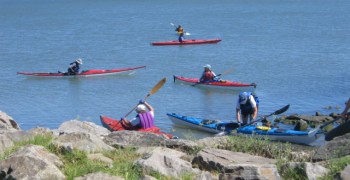
Things changed in the 70′s when the India Basin Industrial Park and a water treatment plant were built and in 1988, a gusty, visionary Friends group got together to create a waterfront park and restore the creek. Their unique modus operandi is built not on fundraising, but on negotiation with city departments and private developers. Knowing that plans for industrial development include sewer projects, repair facilities and retrofits, “we operated with grants, mitigation funds from major infrastructure projects and private donations,” said the Friends’ founder, Julia Viera. First came their chainlink fence for the Outriggers Canoe Club (built with Port permission). Then, when canoers moved out, kayakers applied to move in and Friends struck a deal to buy a shipping container to store their boats securely. Now, says Viera’s successor Robin Chaing, they’re waiting only for final BCDC approval before the kayaks arrive. Chiang says the Port Planning Department has been “invaluable” in helping with permits and working with the Bayview Precinct of the San Francisco Police Department in reducing vandalism and theft.
Community groups and Supervisor Sophie Maxwell are supporting Friend’s proposal to develop a food production center for preparing meals to be sold in cafes and markets (a rapidly growing business) and for compatible low and midrise housing. And above all, literally, looms the famous copra crane that unloaded dried coconut until 1974. Preserved as a labor landmark, it will be restored by retirees from maritime-related unions when donation of the needed materials can be arranged. Meanwhile it towers like a benign dinosaur over this up-and-coming community.
Pier 94 Wetlands
The Pier 94 Wetlands are located in the northeast corner of Pier 94 and have become a rare and valuable bird habitat after an extreme makeover. Known as a wetland enhancement, the project was carried out by the Port, with funding from the San Francisco Bay Natural Resources Trust and the California Coastal Conservancy. After the removal of fill material, concrete, asphalt, tires, wood and litter created the 1.5 new acres within the existing five-acre salt marsh, which serves as a hostel for an astonishing array of shorebirds, waterfowl, and aquatic wildlife. Here and in neighboring Heron’s Head Park, bird watchers have spotted avocets, cormorants, coots, green-winged teals, American widgeons, sandpipers, gulls, even an occasional egret. At last count some 100 species of birds have been seen in the area.
The Golden Gate Chapter of the Audubon Society has adopted the Pier 94 site, hosting regular volunteer workdays and wildlife viewing events. And the Port plans to protect the marsh and an adjacent buffer zone from nearby industrial development.
Heron’s Head Park
Heron’s Head Park was known as Pier 98 when the Port began filling the bay for a projected shipping terminal in the early 1970s. The terminal was never built and over time and exposure to the tides, the approximately five acres of salt marsh developed along the southern shoreline. In the late 1990s, with funding from the Public Utilities Commission, the California Coastal Conservancy and the San Francisco Bay trail Project, and the Port, the Port undertook a major renovation of the pier. Removing over 5,000 tons of asphalt, concrete, metal and other debris, it expanded the marsh, created a tidal channel to improve circulation and constructed upland trails, picnic and bird-viewing areas.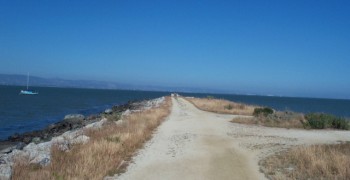
In mid-1999 the former Pier 98 officially reopened as Heron’s Head Park, taking the name from its resemblance, when seen from the air, to a valued resident -the great blue heron. From the beginning, the Port has collaborated with the community’s residents, encouraging education and stewardship.
It brought in Literacy for Environmental Justice, a local, non-profit organization that provides educational programs for urban youth. LEJ programs include salt marsh habitats, bird and native plant identification, and ecological stewardship. The organization engages more than 1200 students and community volunteers every year whose work includes removing invasive plants and putting in a variety of native ones. They play an essential part in Park maintenance says Carol Bach, the Port’s Environmental and Regulatory Affairs Manager. Within the next year LEJ hopes to complete construction of the Eco Center at Heron’s Head Park. The Eco Center, funded by grants from the City and County of San Francisco Department of the Environment and the California Coastal Consercancy, will be an environmetnal education center and a model for sustainable building and construction. Another important event in the Parks’s life is the closing of the adjacent Hunter’s Point PG&E power plant which a company spokesman announced was expected to take place this spring.
For more information about Heron’s Head Park please visit the SF Port website.
India Basin Shoreline Park
India Basin Shoreline Park first appeared on the map in the 1860s. Its name, of uncertain origin, is said to have come from the India Rice Mill Company ships that landed there. In 1907 the legislature passed an act authorizing “a tidal basin for piers, harbors, and appurtenances,” and ships crowded into the new harbor. Some never sailed out again, times changed and by the mid-1920s, India Basin became known as a ‘river boats’ bone yard for derelict vessels.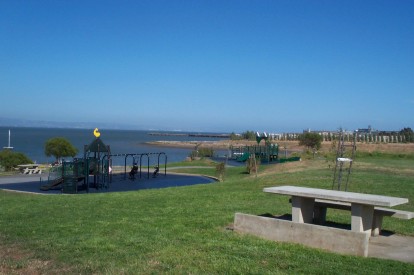
Next the area turned into a busy waterfront for the boat-building industry and the Navy’s Hunters Point shipyard. At the historic Anderson-Cristofani boatyard, Jack London’s famous ketch the “Snark” was built. As the boatyard business dwindled and the Navy pulled out of the Hunters Point, India Basin declines. its waterfront land was divided into lots, bought up by individual buyers and settled by squatters. In 1989, the Board of Supervisors approved acquisition of the property when the Recreation and Park Department wrote, “In addition to providing shoreline access with outstanding views and mild weather, and open space opportunities in the Bayview Hunters Point area, (it) will also serve as an important link in the proposed Bay Trail.”
In 1999, India Basin Shoreline Park was named a Renaissance Park by Mayor Willie Brown and in 2000 the India Basin Shoreline Park Project got underway, powered by Proposition 12, and a coalition of major environmental agencies. The project included completing the portion of the Bay Trail running through the park, expanding green space and constructing a Natural Area, a look-out point, benches, trees, swings, a multi-purpose ball court, play structures and a superslide. Completion of the park’s stunning makeover was celebrated in October, ’03. “We’ve been wanting these features since the neighborhood first initiated a park plan in 1978,” says Jill Fox, a leaders of the India Basin Neighborhood Association.
Next up, she says, is building a restroom, drinking fountain and community bulletin board. Then comes the ultimate project- expanding the park into an historic maritime recreation center. Stay tuned.
For more information about India Basin Shoreline Park please visit the SF Recreation and Parks website.
Hunters Point Shipyard
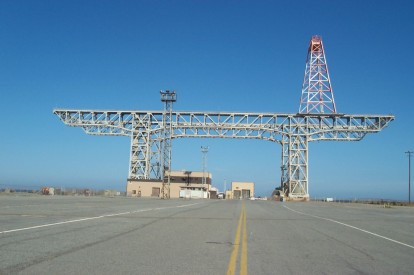
For more information about the Hunters Point Shipyard please visit the SF Redevelopment Agency website.
Yosemite Slough
Coming Soon…
Candlestick Point State Recreation Area
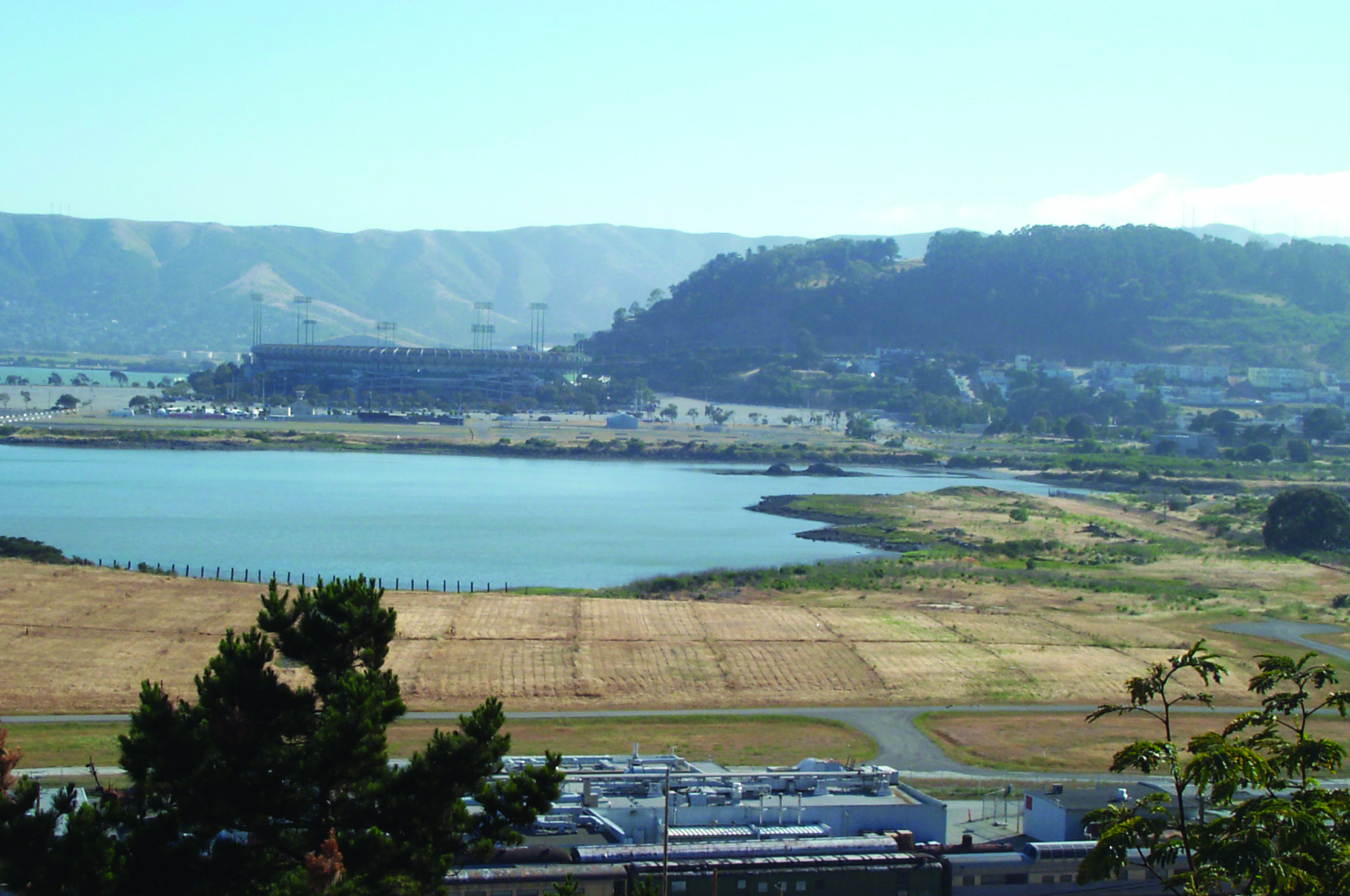
Candlestick Point State Recreation Area is more than an arena for 49′ers fans. The 252-acre park with panoramic views of San Bruno Mountain, the East Bay hills and San Francisco Bay offers a variety of recreational activities for thousands of city dwellers. Its name dates back to the 1800s, when a U.S. Coast Guard survey noted a rock outcropping resembling a candlestick. In World War II, the Navy filled in tidelands to create the nearby Naval Shipyard, now closed. Today the park that sits on this landfill provides a gateway in fresh air and open space.
It was the first California State Park purposely acquires to offer a range of recreational activities to city residents of varying physical abilities. Visitors can choose between walking or bicycling along its accessible trails, fishing on its piers, picnicking, checking out the clams, and shorebirds in the wetland, planting in the community garden plots or windsurfing on a wind-whipped bay. There are accessible restrooms at Plover Group Picnic Area and Sunrise Point; picnic tables with barbecue grills at Plover and more picnic tables at Last Port Area. Home to squirrels and rabbits are other wildlife, the park is a year-round, 8am-to-sunset boon to city dwellers all over the Bay Area.
For more information about Candlestick Point State Recreation Area please visit the SF Redevelopment Agency website, or the California State Parks website.
Park Descriptions adapted from “A Birds Eye View” written by: Jeanne Alexander